
Slow External API Calls in WordPress: Find the Plugin and Fix the Wait
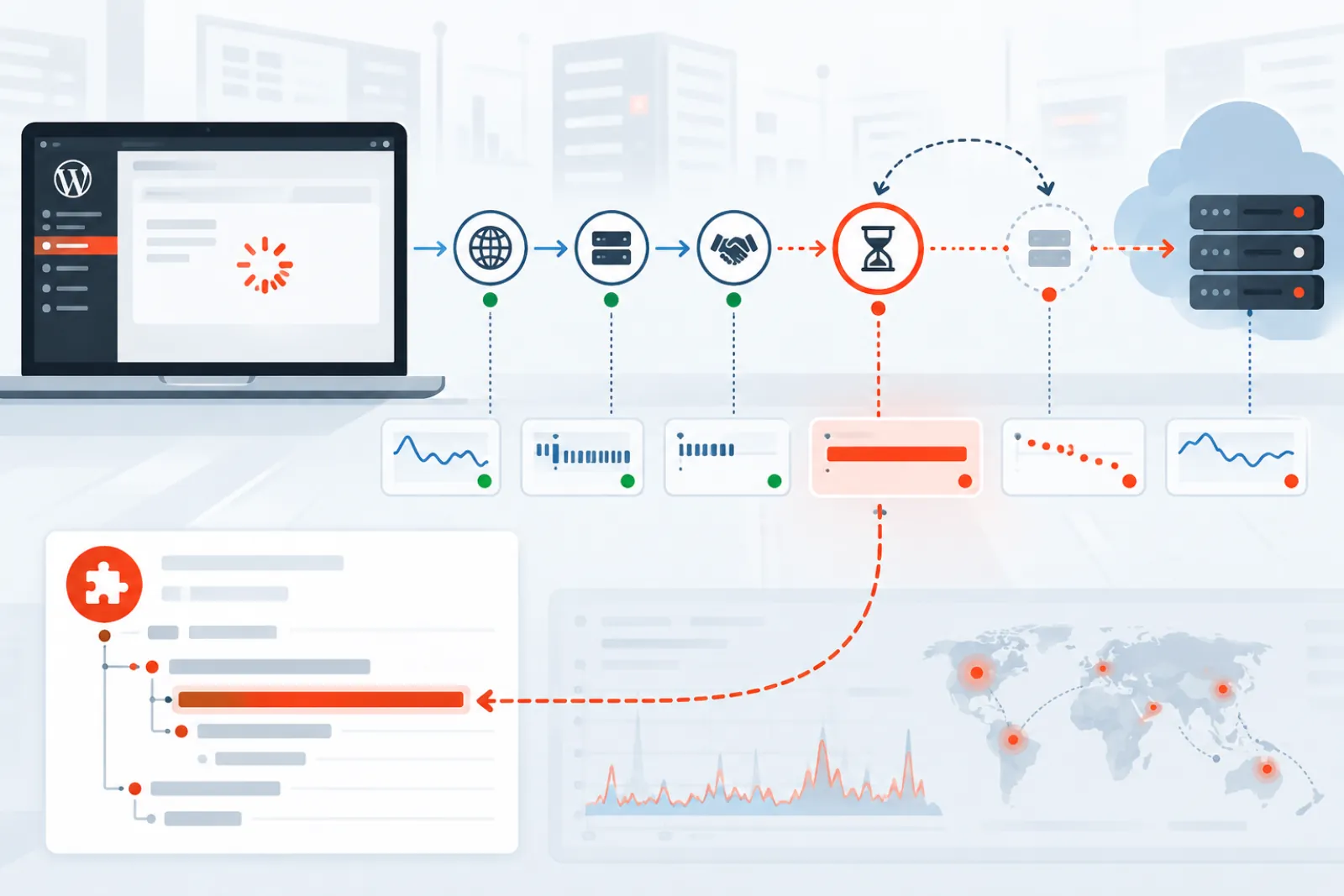
One blocking external HTTP call can add its entire wait to a WordPress page or admin action. Update services, licenses, payments, shipping, tax, AI, CRM and webhooks all use remote requests. The fix is to identify the destination, caller, timing and business requirement—not to block the internet globally.
Recognize the fingerprint
| Pattern | Likely cause |
|---|---|
| Delay equals a round timeout such as five seconds | Unreachable or slow upstream |
| Only wp-admin is slow | Update, license or dashboard feed call |
| Only checkout is slow | Payment, tax, fraud or shipping dependency |
| Repeated identical calls | Missing cache, broken transient or loop |
| Fast application time but queued workers | Many concurrent requests waiting remotely |
Capture the exact call
WordPress’s http_api_debug hook fires after an HTTP API response and exposes the URL, parsed arguments, transport and response. Pair it with start timing around the HTTP API and a caller trace in a controlled diagnostic environment. Redact authorization headers, query tokens, personal data and response bodies before logging.
Record destination host, method, timeout, blocking mode, response code, error, elapsed time, caller plugin and request path. A URL alone does not establish fault; the upstream may be healthy while DNS, TLS, proxy or local firewall work is slow.
Decide whether the user must wait
- Must be synchronous: payment authorization or live tax required to complete the action.
- Can be cached: license status, dashboard feeds or stable reference data.
- Can be queued: analytics, notifications and many outbound webhooks.
- Can fail open or closed: decide from security and business consequence, not convenience.
Fix repeated and slow calls
Use bounded timeouts, validated caches, conditional requests and backoff. Do not retry a five-second failure three times inside one page load. Move noncritical work to an idempotent background queue. For critical synchronous services, show a clear error and preserve safe retry semantics.
Break down the network path
Total elapsed time can include DNS resolution, TCP connection, TLS negotiation, request upload, upstream processing, response download and local parsing. WordPress-level timing often shows only the combined total. Use server or application tracing when you must distinguish a slow upstream from local DNS, certificate, proxy or IPv6 problems.
Design the cache contract
Define cache key, freshness, maximum stale period, invalidation and failure behavior. License or update checks may tolerate stale data; prices, inventory or payment decisions may not. Prevent a cache stampede by allowing one worker to refresh while others serve safe stale data where the business permits.
Design retries around idempotency
A GET can still have upstream side effects, and a POST may be safely retryable only with an idempotency key. Retry only selected transient failures, add jittered backoff and cap attempts. Never retry authentication failures or invalid payloads as if time will repair them.
Protect privacy in diagnostics
Performance tools may see full URLs, SQL patterns and plugin names. Strip tokens, email addresses, order identifiers and query strings before persistence or optional LLM analysis. Restrict snapshot access to administrators, define retention and avoid logging response bodies by default.
Worked example
The Plugins screen takes 12 seconds and shows three calls to the same license endpoint. Each call times out after four seconds because an object-cache problem prevents the status transient from persisting. Blocking all external traffic makes the screen fast but breaks updates. Repairing the transient and reducing redundant checks removes the wait without disabling the service.
Verify under upstream failure
Retest normal, slow and unavailable service states. Confirm interactive response time stays within the declared budget, the user receives an actionable message, queued work eventually completes and recovery does not send duplicates. Monitor destination-specific latency rather than a single aggregate “HTTP time.”
Test failure deliberately
- Baseline a successful call.
- Simulate slow response, timeout, DNS failure, 429 and 500.
- Verify timeout and retry limits.
- Confirm secrets are absent from logs.
- Test cached or queued fallback.
- Measure worker occupancy under concurrency.
- Confirm recovery after the upstream returns.
Choose the right failure behavior
Classify the dependency as required, deferrable or optional. Required calls need a strict timeout and useful failure state. Deferrable calls belong in a durable queue with idempotency and monitoring. Optional calls should fail without blocking the page. Cache only responses whose staleness is acceptable, and never retry a non-idempotent request blindly. Record host, route class, duration and outcome without credentials or personal payloads.
Create a destination-level HTTP inventory
List host, owning plugin, feature, request routes, method, normal frequency, timeout, retry policy, cache, credentials, data class and business consequence. Group dynamic URL paths under the host without retaining tokens. An inventory turns an unexplained five-second pause into an accountable dependency.
| Dependency | Must user wait? | Default resilience |
|---|---|---|
| Payment authorization | Usually yes | Strict timeout, idempotency and explicit failure |
| Tax or shipping quote | Often yes for checkout | Short budget, validated cache where rules permit |
| License status | Rarely on every admin view | Cached status and asynchronous refresh |
| Analytics or webhook | No | Durable queue with bounded retries |
| Dashboard news feed | No | Cache or omit without blocking |
Measure before and after the WordPress HTTP layer
Record a timestamp immediately before the call and use http_api_debug for the result. Capture elapsed time, URL host, method, timeout, blocking flag, response code or error, response bytes and sanitized caller. Match it to the containing request’s route and total duration.
Instrumentation must have low overhead and bounded retention. Sample healthy calls, retain slow and failed categories, and never log authorization headers or bodies by default. Remove temporary tracing when the investigation ends or convert it into deliberate monitoring.
Diagnose DNS, connection and TLS delay
Test name resolution from the WordPress host, not a laptop. Compare IPv4 and IPv6 when the environment supports both, inspect resolver failures and verify the destination chain. A stale AAAA record or slow resolver can consume the timeout before the upstream application sees a request.
Check TCP connection reuse, proxy routing, certificate validation, SNI and intermediate chains. Do not disable TLS verification to make a test pass. Correct certificates, trust stores, clocks or proxy configuration. Security regression is not a performance fix.
Allocate a request latency budget
Start from the user action’s acceptable total time and reserve portions for WordPress, database, remote dependencies and rendering. A checkout with three sequential services can exhaust its budget even when each stays under a generic five-second timeout. Parallelize only independent safe reads and only when the implementation and host support it.
Set connect and total timeouts from observed service behavior and consequence. A timeout should end waiting before the user and worker budget is exhausted. Record the chosen value and review it when providers or routes change.
Eliminate duplicate calls at the owner
Trace why the same destination is contacted more than once. Multiple widgets may request identical data, a transient may never persist, or separate hooks may perform one license check. Build a request-local memo and a shared cache only when responses and authorization scope allow it.
Include all inputs in the cache key, but exclude secrets from logs. Prevent stampedes by allowing one refresh owner and serving safe stale data when policy permits. Do not share customer-specific prices or permissions through an under-scoped cache.
Move deferrable work to a durable queue
Enqueue a validated reference and return to the user. A worker performs the call, records outcome and retries selected transient failures. The queue needs visibility, backlog age, concurrency limits, idempotency and a failed state; “non-blocking” fire-and-forget requests can vanish without evidence.
For webhooks and notifications, show delivery status separately from the primary transaction. Do not tell the user an email was sent merely because a job was queued. Define the product behavior when delivery ultimately fails.
Design safe stale and fallback behavior
Stable reference data may use stale-while-revalidate: serve a known response within a maximum stale period while one worker refreshes it. Checkout totals, access decisions and fraud results may require fail-closed or a carefully approved fallback. Document the decision with product, security and legal owners.
Display freshness where it matters. A cached shipping estimate from yesterday should not masquerade as live. If no safe fallback exists, fail quickly with an actionable retry rather than holding a worker until the upstream’s maximum timeout.
Worked case: tax service stalls checkout
A tax API normally responds in 300 milliseconds but occasionally takes eight seconds. The plugin retries twice inside the checkout request, occupying workers for up to twenty-four seconds. Customers submit again and create duplicate attempts.
The team sets a measured total budget, removes inline retries, adds idempotency to order attempts and presents a clear temporary failure. It works with the provider on tail latency and uses only legally approved caching. Load tests show checkout workers recover under simulated timeouts.
Worked case: dashboard feed blocks every admin page
A plugin attaches a promotional feed request to a broad admin hook. When its endpoint fails, every wp-admin page waits five seconds. The content is optional, but the call is synchronous and uncached.
The owner scopes the feature to its own screen, caches a sanitized response and refreshes asynchronously. On failure, the panel shows its last update or nothing; settings and publishing remain available. The change removes the dependency from unrelated admin requests.
Test retries and recovery
Simulate timeout, refused connection, DNS failure, invalid certificate, 429 with retry guidance, selected 5xx, 401 and invalid payload. Confirm only transient classes retry, backoff includes jitter, attempt count is capped and non-idempotent effects are protected.
When service returns, queued work should drain at controlled concurrency rather than create a recovery storm. Watch provider limits, backlog age, worker occupancy and duplicates. Recovery is part of the failure test.
Monitor by dependency and route
Track call count, success, timeout, error class, p50/p95/p99 latency, retries, cache hit, stale serve, queue depth and containing request route. Alert on sustained user-impacting change. A single global HTTP average hides one failing provider.
Review credentials, timeouts, cache rules and ownership quarterly and after provider changes. Remove abandoned integrations rather than allowing their health checks to remain in the request path.
Deployment checklist
- Capture baseline and sanitize diagnostic evidence.
- Classify the dependency as synchronous, cacheable, deferrable or optional.
- Implement one scoped timeout, cache or queue change on staging.
- Test normal, slow, failed, rate-limited and recovery states.
- Verify idempotency, privacy, cache scope and user messaging.
- Load-test worker occupancy with representative route mix.
- Deploy with rollback and monitor the original failure window.
Validate responses before caching or acting
An HTTP 200 does not prove the response is usable. Validate content type, schema, required fields, size and business status before storing or applying it. Limit decompressed bytes and parsing depth so an unexpected payload cannot exhaust memory. Treat HTML error pages returned with 200 as failures.
For signed responses or webhooks, verify authentication and replay protection before side effects. Keep validation errors as coarse categories in monitoring; do not log entire bodies containing customer or provider data.
Control redirects and destination changes
Set a bounded redirect count and validate each destination against the intended security policy. An allowlisted host can redirect to an internal address, expired domain or insecure scheme. Review whether credentials are forwarded and prevent them from crossing origins unexpectedly.
Track provider hostname changes through configuration and release review. Hard-coded emergency rewrites can survive long after an incident. Store endpoints as protected configuration with an owner and test environment.
Prevent server-side request forgery
If a user or imported record influences a remote URL, parse and validate scheme, host and port against a strict allowlist. Resolve and protect private, loopback, link-local and metadata-service addresses according to the architecture. Revalidate redirects. WordPress’s safer remote-request helpers can support this boundary, but application rules still matter.
Do not fetch arbitrary URLs simply to generate previews or test integrations. Apply capability checks, nonces for administrative actions, rate limits and audit logs. Performance and security failures often share the same unbounded request surface.
Write a provider contract and runbook
Document service owner, support route, expected latency, availability, rate limits, authentication rotation, timeout, retryable status classes, idempotency, data processing, cache rules and failure behavior. Record the business features that depend on it. This becomes the reference when a plugin default conflicts with operational needs.
Include how to disable or degrade the integration, how queued work is reconciled, and who may fail open or closed. Keep the runbook available outside WordPress because wp-admin may be unavailable during worker saturation.
Worked case: webhook delivery belongs after commit
An order-save hook sends a CRM webhook synchronously before confirming the WordPress response. The CRM slows, customers wait, and browser retries create duplicate requests. The webhook is important but does not need to block the order screen.
The integration commits the order first, enqueues a job with the order event ID, and returns. A worker sends the webhook with a stable idempotency key. The order screen shows delivery status separately, and exhausted failures alert an owner. Checkout response no longer inherits CRM latency.
Worked case: unsafe cache mixes customer prices
A developer caches a pricing response by product ID but omits customer group and currency. Remote latency disappears, yet wholesale prices appear for retail users. The cache solved speed by breaking correctness.
The team purges the cache, restores authoritative pricing and rebuilds the key from every business input. It sets a short approved freshness and adds cross-account tests. Cache isolation is part of correctness, not an implementation detail.
Capacity-plan dependency failures
Load-test the route mix while the provider responds normally, slowly and not at all. Measure occupied PHP seconds, queue time, retry volume, database connections and queue backlog. One long timeout multiplied by concurrent requests can exhaust workers even when CPU stays low.
Apply concurrency limits and circuit-breaking behavior only with a clear recovery design. When the failure threshold opens the circuit, define the user message, stale data and probe that closes it. A permanent open circuit can hide recovery.
Close the incident with evidence
Confirm p95/p99 dependency latency, containing request time, worker occupancy, errors, cache or queue behavior and business outcomes through the original window. Verify secrets were not captured during tracing. Remove temporary instrumentation or give it an owner and retention.
Record root cause, contributing network layer, code change, provider communication, rollback and regression scenarios. Similar five-second delays can come from DNS, TLS, upstream processing or local retries; keep the diagnosis specific.
Audit WordPress hooks that trigger remote work
Map calls to the hook and screen that owns them. Broad hooks such as admin initialization, every page load or every save can make a narrow integration affect unrelated work. Verify capability and feature state before contacting the provider. Avoid remote health checks merely to decide whether a menu item should render.
For save hooks, separate the database transaction from deferrable notifications. For REST and AJAX, return a bounded error rather than waiting through multiple retries. Test duplicate hook registration after plugin activation and updates.
Use conditional requests where supported
For stable public resources, retain provider validators such as ETag or Last-Modified and send conditional requests. A not-modified response can reduce transfer and parsing, though connection and upstream time still exist. Respect cache headers only when they align with business freshness and authorization.
Do not apply shared conditional caches to personalized or permission-sensitive responses. Validate Vary, account and locale inputs. Cache correctness comes before hit rate.
Review external dependencies before launch
For every new plugin integration, ask whether calls occur during public requests, checkout, login, admin navigation or cron. Require a failure-mode test, timeout, retry policy, data-flow review and owner. A dependency that cannot fail without taking down routine administration needs redesign or an explicit risk acceptance.
Keep a staging mock that can return normal, slow, malformed, rate-limited and unavailable responses. Run it in release testing so resilience does not depend on provoking a real provider outage.
Definition of done
- The exact destination, caller, route and latency contribution are proven.
- The user waits only when the business action requires a synchronous result.
- Timeouts, retries, redirects and payload validation are bounded.
- Caches are scoped correctly and queues are durable and idempotent.
- Normal, slow, failed and recovery tests pass under concurrency.
- Secrets and customer payloads remain absent from diagnostics.
- Dependency monitoring, runbook, owner and rollback are recorded.
Maintain a dependency review cadence
Review top external hosts monthly on high-traffic or revenue-critical sites. Compare request volume, p95 and p99 latency, timeout rate, retries, cache effectiveness and queued backlog. Annotate provider incidents, credentials changes and plugin releases.
Remove calls for disabled features and retired vendors. Reconfirm failure behavior and data-processing terms. A dependency can become risky because its use expands even when its average latency stays flat.
Keep one synthetic transaction per critical service using test credentials. Run it at a safe frequency and exclude it from business analytics. The result should exercise DNS, TLS, authentication, schema and recovery without creating real charges or messages.
Prepare support evidence without leaking data
Share timestamps, region, sanitized host, status or error, latency distribution, request size, retry behavior and a reproducible test. Remove authorization, query tokens, customer IDs and payload bodies. State whether the issue reproduces outside WordPress from the same host.
Ask the provider for incident status, server timing and rate-limit interpretation. Keep their response with the internal runbook so future operators do not repeat the same network and application tests.
Record the final verified timeout, cache, queue and retry configuration beside the provider contract. Re-test it after endpoint, authentication, network or plugin changes. A previous successful failure drill is not permanent evidence when the dependency path has changed.
Include the integration in restore and disaster-recovery exercises. Confirm that restored queue records do not resend completed financial, customer or messaging actions, and that lost cache state does not create an uncontrolled burst toward the provider. Recovery behavior is part of the dependency design.
How WPStack TOP Load Monitor helps
WPStack TOP Load Monitor records request context, hook timing and a timeline designed to surface HTTP-related work alongside queries, memory and errors. Snapshot comparison helps show whether the remote wait owns the delay. Deeper DNS/TLS timing may still require infrastructure tracing.
Related WPStack guides
Frequently asked questions
Should I set every timeout to one second?
No. Choose from service behavior and business consequence. Too-short timeouts create false failures.
Is a non-blocking request always safe?
No. Delivery and error handling become less certain. Use a durable queue when the action matters.
Can caching hide an outage?
Yes. Define freshness, stale-serving and alerting explicitly.
Should URLs be logged?
Log only sanitized destinations; query strings can contain tokens or personal data.
References

Aditya Bhimrajka is a technology entrepreneur, product strategist, and software solutions expert with over a decade of experience building scalable web and mobile applications. His expertise spans SaaS, AI, cloud technologies, custom software development, and digital transformation. Passionate about solving real-world business challenges through technology, Aditya shares practical insights on WordPress, plugins, software development, startup growth, product strategy, and emerging technologies. At WPStack, he writes actionable, experience-driven content that helps developers, businesses, and website owners build secure, high-performing, and future-ready WordPress solutions.