
How to Find Overlapping WP-Cron Jobs and Stop Repeat Load Spikes
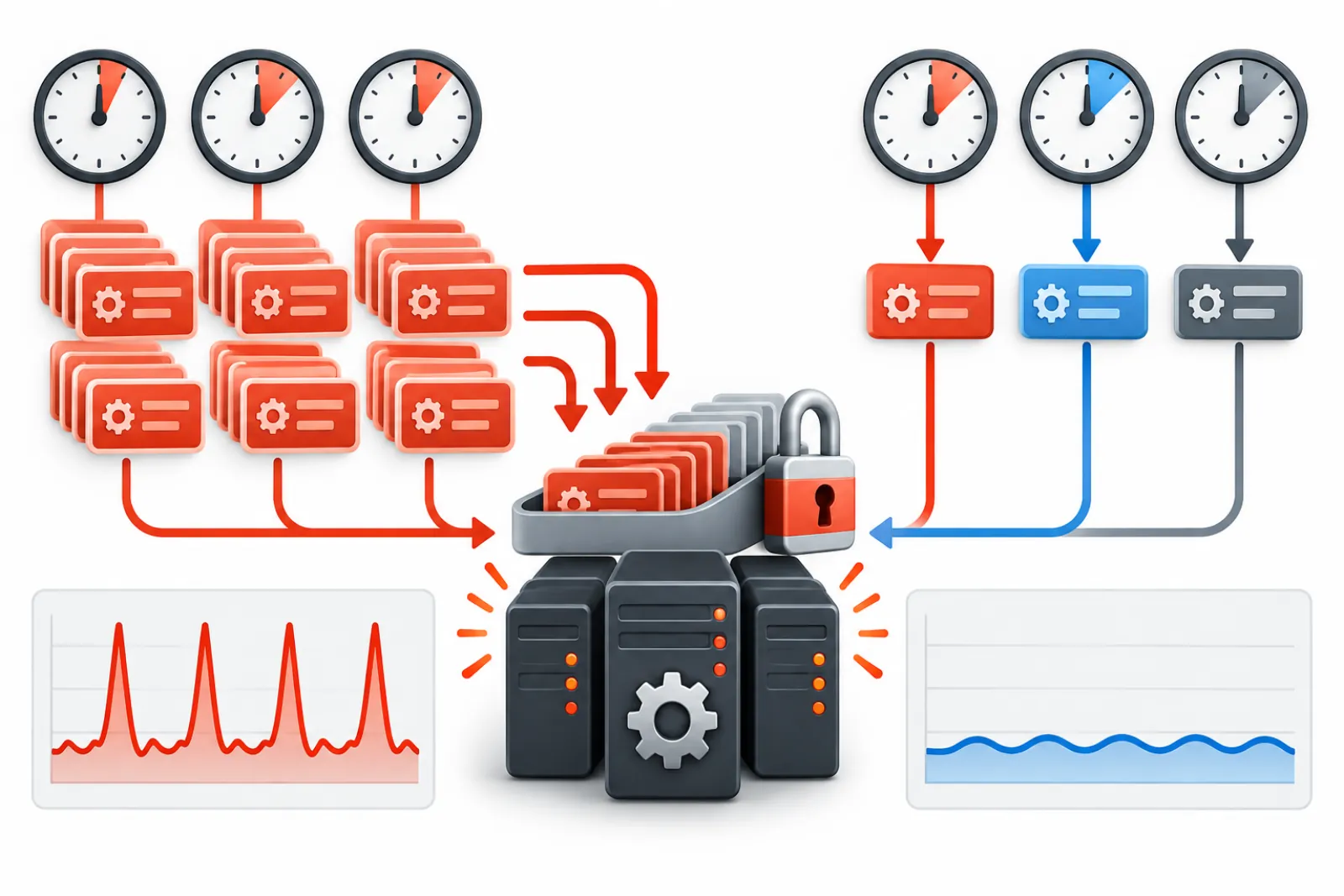
A recurring WP-Cron event should not start again while its previous run is still consuming resources. Overlap occurs when runtime exceeds the interval, duplicate events were registered, a lock is missing or a failed job immediately retries. The result is periodic CPU, memory and database spikes—even when every individual callback eventually succeeds.
Duplicate schedules and overlapping execution differ
| Problem | Evidence | Fix direction |
|---|---|---|
| Duplicate registration | Same hook and arguments appear many times | Guard scheduling with wp_next_scheduled() |
| Runtime overlap | Next start occurs before previous finish | Lock, split work or increase interval |
| Backlog | Many overdue distinct jobs | Repair loopback/system trigger and drain carefully |
| Retry storm | Failures reschedule rapidly | Bound retries and add backoff |
Inventory the schedule
List hook, arguments, recurrence, next run and owner. Arguments are part of a WordPress cron event’s identity; small differences can create separate schedules. Compare the registry with activation and scheduling code. Never delete unknown core or plugin events merely because the hook name looks unfamiliar.
Measure actual execution
The schedule shows intent, not duration. Record start, finish, peak memory, database time, external calls, items processed and result for each callback. Match these records to request snapshots and hosting graphs. If a five-minute job runs for eight minutes, overlap is a design condition, not random traffic.
Make callbacks safe
- Acquire a lock with an expiry longer than normal runtime but shorter than the incident window.
- Process bounded batches and store a cursor.
- Make work idempotent so retries do not double-send or double-charge.
- Use exponential backoff with a retry cap.
- Release locks in a finally-style cleanup path.
- Alert on stale locks and repeated failure rather than silently skipping forever.
Stagger heavy work
Do not schedule backups, imports, reports and media jobs at the same minute. A system scheduler can trigger WordPress reliably, but it does not remove callback cost. Choose intervals from business freshness and measured capacity; spread heavy tasks and reserve workers for checkout and administration.
Choose a locking strategy
A transient lock is simple but depends on a reliable shared object or database store. The lock value should identify the run and its start time; deletion should occur only when the same run owns it. A fixed expiry prevents permanent blockage after a fatal error, but it must exceed expected execution or a second run may begin while the first is alive.
For high-value jobs across multiple web nodes, use an atomic database or queue primitive designed for concurrency. “Check then set” code can race when two workers start together.
Batch by work, not arbitrary time
Process a bounded number of records or a bounded byte volume, persist a cursor and schedule the next batch. Each batch should be independently retryable. Mark items complete only after the external side effect succeeds, and use idempotency keys for payments, emails or webhooks.
Diagnose a backlog safely
Before running all due events, estimate count and cost. Trigger one known hook on staging, observe its resource use, then drain production in controlled groups. Running every overdue callback at once can turn a scheduling fault into an outage. Preserve the registry export and do not unschedule core maintenance without a replacement.
Worked example
A plugin schedules its hourly event on every init call without checking wp_next_scheduled(). Hundreds of identical events collect. Removing duplicates treats the backlog, while fixing registration prevents recurrence. The callback is then changed to process 100 records with a lock, so one delayed run cannot overlap the next.
Monitor the repaired system
Track due-to-start delay, execution time, failure rate, retries, lock contention and backlog depth per hook. Alert when runtime approaches the interval or a lock remains beyond its expected window. Successful completion matters more than a clean event list.
Make recurring jobs overlap-safe
Use a lock with an owner token and an expiry longer than normal runtime but shorter than the recovery objective. Release it only if the owner still matches. Make batches idempotent and checkpoint progress so retries do not resend email or restart from zero. Alert when runtime approaches the schedule interval—the system is losing headroom before two jobs visibly collide.
Understand how WP-Cron is triggered
WP-Cron stores scheduled events but normally depends on site requests to notice due work and spawn a loopback. Low-traffic sites may run late; high-traffic sites can attempt frequent spawning while a lock controls actual execution. A system scheduler can call WordPress at a reliable cadence, but it does not change callback correctness.
Record whether DISABLE_WP_CRON is set, what system trigger replaces it, and whether loopback requests succeed. Never disable request-driven spawning without verifying an external trigger. Scheduled posts, cleanup and plugin maintenance may otherwise stop silently.
Inventory events with arguments and ownership
Event identity includes hook and arguments. Two hooks with the same name but different site, account or cursor arguments may be legitimate distinct work. Export timestamp, recurrence, arguments hash, next run and schedule source. Redact secrets and personal data in arguments.
Search activation, upgrade, init and settings code for scheduling calls. Look for missing wp_next_scheduled() guards, changed argument shapes and version migrations that left old events behind. Confirm uninstall and deactivation behavior before unscheduling.
| Observation | Likely cause | Safe next step |
|---|---|---|
| Many identical hook and argument pairs | Unguarded registration or migration defect | Fix registration, then remove exact duplicates with backup |
| One recurring event with concurrent runs | Runtime exceeds interval or lock fails | Add atomic ownership lock and bounded batches |
| Many different overdue hooks | Trigger or loopback failure | Repair triggering and drain by measured cost |
| Fast repeated failures | Retry without backoff or terminal classification | Cap attempts and distinguish permanent errors |
| Stale lock blocks every run | Owner crashed or expiry is wrong | Verify no live owner, recover cursor and replace lock design |
Design an atomic ownership lock
A safe lock acquisition must be one indivisible operation. A separate “does key exist?” check followed by “set key” allows two workers to pass simultaneously. Use an atomic database, cache or queue primitive supported by the architecture. Store a random owner token, start time and expiry.
Release only when the current value still carries the same token. Otherwise an old worker can delete a lock acquired by a newer run after expiry. Choose expiry above observed p99 runtime plus headroom, and renew cautiously only when the same live owner is making progress.
A lock prevents overlap; it does not guarantee completion. Alert on skips, stale locks and jobs that repeatedly reach expiry. Preserve a manual recovery procedure.
Make side effects idempotent
Assign a stable operation key to emails, payments, webhooks, exports and record transformations. Before repeating a side effect, determine whether the same operation already succeeded. Store completion only after the external or database action is confirmed.
Design partial failure. If a batch sends 80 of 100 emails before timeout, the retry should send the remaining 20, not all 100. External APIs may support idempotency keys; when they do, keep the key stable across retries.
Choose a batch and cursor strategy
Bound work by records, bytes or elapsed time. Persist a cursor representing committed progress and validate that source ordering remains stable. For mutable datasets, use immutable IDs or a queue rather than page numbers that can shift during processing.
Measure per-item cost and set a batch below PHP, worker and external-service limits. Schedule the next batch with enough delay to protect interactive traffic. A smaller batch increases overhead but limits failure blast radius; choose from evidence.
Classify retries
Retry timeouts, connection failures and selected 5xx responses with exponential backoff and jitter. Do not retry invalid credentials, malformed input or authorization failures until configuration changes. Cap attempts and send exhausted jobs to an operator-visible failed state.
Include attempt count, next time and last error category without storing sensitive payloads. A retry storm often consumes more resources than the original failure. One queue owner should control rescheduling so both callback and external system do not multiply attempts.
Drain an overdue backlog without causing an outage
Group due events by hook and estimate one run’s CPU, memory, database, external calls and duration on staging. Prioritize business-critical, time-sensitive and low-cost work. Pause obsolete or harmful jobs only after owner confirmation. Set concurrency and process small windows.
Monitor worker occupancy, database load, cache latency, external rate limits and interactive response time while draining. Stop when guardrails breach. Update backlog depth and oldest age so progress is visible. Do not click “run all” on thousands of unknown events.
Worked case: hourly report overlaps itself
An hourly analytics report takes 78 minutes after the dataset grows. Each run scans the full period, writes a large option and sends a webhook. By afternoon, two instances overlap continuously, and retries duplicate notifications.
The plugin changes to incremental daily partitions with a cursor, uses a token lock and sends the webhook with an idempotency key after report commit. Runtime falls below twelve minutes. Alerts fire if p95 exceeds forty minutes, leaving headroom before the next hour.
Worked case: a stale lock hides failure
A cleanup callback writes a transient lock without expiry and crashes during file deletion. Future runs see the lock and return successfully, so the event list looks healthy while storage keeps growing.
Recovery confirms no live worker, restores the last checkpoint and removes the orphaned lock. The new lock carries expiry and owner token; skipped runs emit a metric, and the cleanup’s success requires final-state reconciliation. Silence no longer counts as completion.
Protect scheduled publishing and essential maintenance
Before changing cron triggering or removing duplicates, list core and editorial events due during the window. Test scheduled posts, privacy exports, update checks and site health. Keep a database export of the cron registry and record exact events removed.
A production incident is not permission to delete unknown hooks. Contain the proven offender and maintain the trigger for unrelated work. If the entire scheduler must pause, communicate the business impact and define how missed events will be recovered.
Monitor by hook and outcome
Track scheduled time, actual start, queue delay, runtime, outcome, items, memory, database time, external wait, lock contention, retries and next run. Use p50 and p95 by hook. Alert when runtime consumes a material portion of interval, backlog grows or success stops.
Separate “skipped because another owner runs” from success. Occasional skip can be correct; repeated skip means insufficient headroom or a stuck owner. Review metrics after releases and data-volume changes.
Deployment and rollback plan
- Export schedules, queue state, cursors and lock keys.
- Fix registration and callback code on staging.
- Test duplicate invocation, crash, timeout and retry.
- Deploy code before deleting duplicate events.
- Clean only exact obsolete schedules in a small batch.
- Run one controlled event and verify business output.
- Monitor at least two cycles and retain the old registry for rollback.
Rollback must restore schedule and cursor consistently without replaying completed side effects. Document the last committed item and idempotency keys.
Schedule events only when lifecycle requires it
Register recurring events on activation or a controlled migration, guarded by an exact hook-and-arguments lookup. Do not schedule on every init without a guard. When recurrence or arguments change, remove the old expected event and add the new one through a versioned upgrade routine.
On deactivation, decide whether work should stop or finish. On uninstall, remove owned events only after confirming shared components do not use them. Tests should activate twice, upgrade twice and deactivate/reactivate without multiplying schedules.
Handle time zones and daylight saving safely
WordPress stores event timestamps in UTC, while business requirements may be stated in local time. Define whether “daily at 2 AM” follows a local clock or a fixed UTC interval. Daylight-saving transitions can skip or repeat a local time. Test the target site’s timezone and seasonal changes.
For billing, publication or legal deadlines, record the intended timezone and use a scheduler suited to calendar semantics. Do not approximate a monthly calendar rule with a fixed number of seconds without testing month length and boundary behavior.
Audit Multisite scheduling
A network-active plugin can schedule one event per site or one central network event. Record blog ID and switch context correctly inside callbacks. A provisioning hook that runs twice can multiply jobs across hundreds of sites, while a central event may accidentally process only the main site.
Inventory in bounded batches and test new-site creation, site deletion and network activation. Locks and cache keys must include the correct scope. One site’s stuck lock should not prevent unrelated sites unless the work is intentionally global.
Choose when WP-Cron is the wrong execution engine
Long, high-volume or externally critical work may fit a durable queue with explicit workers, visibility, retries and concurrency controls better than one recurring callback. WP-Cron can enqueue bounded tasks while the queue processes them. The architectural change is justified when observability and delivery guarantees are requirements, not merely because cron has a poor reputation.
Keep WordPress ownership and capabilities clear. A queue does not remove the need for idempotency, locks, privacy, rate limits and final-state verification. It only provides better primitives when properly operated.
Secure job inputs and logs
Cron arguments, queue payloads and errors may contain emails, tokens, file paths or order IDs. Store references rather than full sensitive objects, validate data again at execution, and restrict administrative views. Redact logs and set retention.
Never accept arbitrary callback names or unserialized data from untrusted users. Background execution runs with application privileges and needs the same authorization and input validation as a web request.
Respond to an active overlap incident
- Identify live owners, hook, arguments, start times and side effects.
- Prevent new starts using the narrowest reversible control.
- Allow or stop current work according to data-integrity risk.
- Preserve schedule, cursor, lock and completed-operation evidence.
- Reconcile partial effects before retrying.
- Repair registration, batching, locking or backoff on staging.
- Resume one controlled worker and monitor to completion.
Do not delete a lock while its owner may still be processing. Do not run the job manually until completed items are known. Availability pressure does not remove the risk of double charge, duplicate email or corrupted export.
Set service objectives for background work
Define maximum start delay, completion time, backlog age, failure rate and retry exhaustion per hook. A scheduled post may require minute-level start accuracy; a weekly report may tolerate hours. Give interactive traffic explicit worker and database headroom.
Alert before runtime reaches the recurrence interval. Trend items processed per second and dataset growth. Capacity should be reviewed when forecast runtime consumes the safety margin, not after overlap begins.
Verification beyond a clean event list
Confirm the business output: reports contain the right period, emails were sent once, webhooks arrived once, media was processed, scheduled posts published and cleanup removed the intended objects. Compare counts to source records and external provider receipts.
Run normal, duplicate-trigger, crash, timeout, external 429 and stale-lock scenarios. Observe at least two full recurrence cycles and one failure/recovery cycle. A list with one event can still conceal a non-idempotent or overlong callback.
Validate lock behavior under real concurrency
Start two workers at the same barrier and verify exactly one acquires the lock. Let the owner run past normal duration, test renewal, then crash it without cleanup. Confirm another worker can recover after the defined expiry without replaying committed side effects.
Test clock skew when lock storage and workers use different clocks. Prefer server-side expiry semantics offered by the lock store. Record contention and owner token in restricted diagnostics, never sensitive job payloads.
Plan manual intervention
Document how an operator identifies the current owner, proves it is no longer active, inspects the last checkpoint, releases or replaces a stale lock and resumes one batch. Require an approval boundary for high-impact jobs such as payments, deletions and customer messages.
A dashboard “unlock” button must enforce capabilities, nonce protection and an explanation of consequence. It should not silently run the job immediately. Show the owner, age and next recovery step.
Keep schedule changes auditable
Record added and removed events, exact hook and argument hashes, old and new recurrence, plugin version, migration ID, operator and reason. Compare the registry after deployment with the expected manifest. Unexpected events belong in an investigation queue.
Review the manifest after plugin upgrades and site cloning. A copied production cron array can bring environment-specific callbacks or endpoints into staging. Sanitize and rebuild schedules through supported activation logic when appropriate.
Coordinate heavy schedules
Create a shared calendar of backups, imports, feeds, reports, media processing and cleanup. Stagger work using measured runtime and resource use, not arbitrary five-minute offsets. Reserve capacity for interactive checkout, login and administration.
When jobs depend on each other, express the dependency through completion state or a queue rather than hoping their clock times line up. A delayed upstream run should not let the downstream process incomplete data.
Review the calendar after traffic growth, data migrations and daylight-saving changes. Scheduling reduces predictable contention, while locks and idempotency still protect unexpected overlap.
Keep one safe canary job that records start, finish, lock and retry behavior without external side effects. Run it after scheduler, cache or hosting changes. It confirms the execution system still honors ownership and timing before critical callbacks depend on it.
Archive the canary result, current schedule manifest and responsible operator. This provides a reproducible comparison when timing or lock behavior changes after a release.
How WPStack TOP Load Monitor helps
WPStack TOP Load Monitor can capture cron context, request runtime, memory, slow and duplicate queries, hook timing and errors in request snapshots. Use its timeline to identify collision windows. It is an observer, not a distributed lock or queue system.
Verification checklist
- Back up the database.
- Export the event list before removing duplicates.
- Fix scheduling code before cleaning the registry.
- Run the callback on staging with representative data.
- Test lock expiry and failed retries.
- Monitor at least two full recurrence cycles.
- Confirm scheduled publishing and unrelated jobs still run.
Related WPStack guides
Frequently asked questions
Why do identical cron hooks appear more than once?
Different arguments create distinct identities, and unguarded scheduling can register duplicates.
Should every cron job use a lock?
Long, destructive or externally visible jobs should prevent unsafe concurrency. Very short idempotent callbacks may not need one.
Does a system cron prevent overlap?
No. It makes triggering reliable; callback locking and batching control overlap.
Can I delete all overdue events?
No. First identify owners and repair the trigger or callback. Some overdue work is required.
References

Aditya Bhimrajka is a technology entrepreneur, product strategist, and software solutions expert with over a decade of experience building scalable web and mobile applications. His expertise spans SaaS, AI, cloud technologies, custom software development, and digital transformation. Passionate about solving real-world business challenges through technology, Aditya shares practical insights on WordPress, plugins, software development, startup growth, product strategy, and emerging technologies. At WPStack, he writes actionable, experience-driven content that helps developers, businesses, and website owners build secure, high-performing, and future-ready WordPress solutions.