
Building Disposable Sandbox & Demo Environments for WordPress Plugins
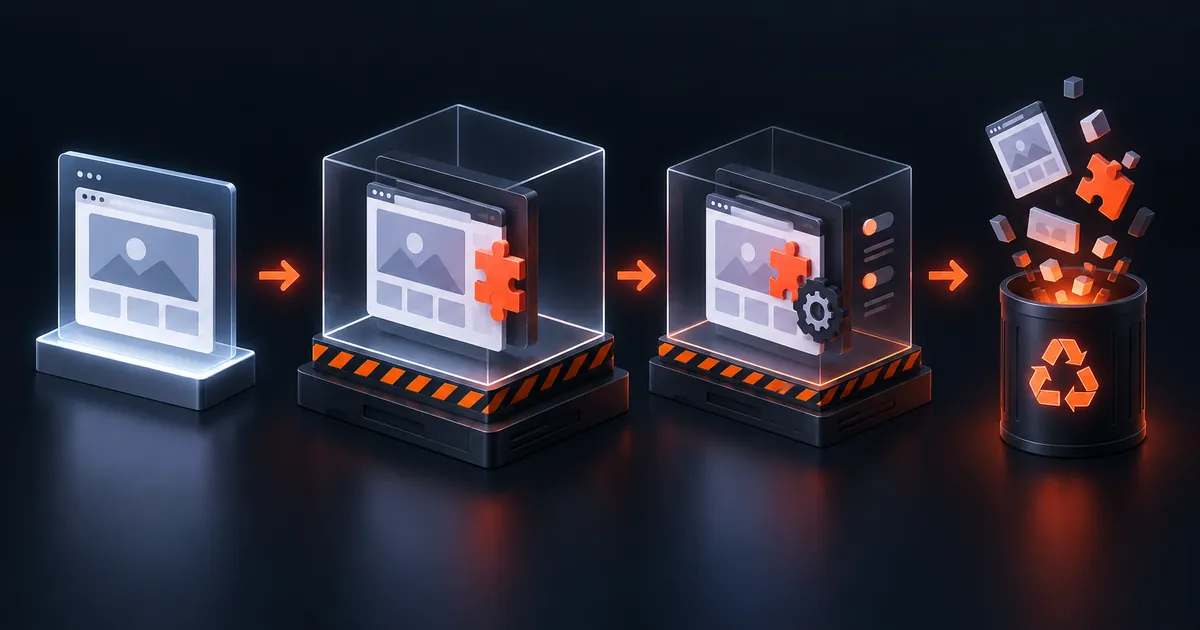
Build automated, ephemeral WordPress demo sandboxes with automatic teardown and instant login. Drive 3x higher plugin trial conversions with zero server bloat.
1. Sandbox Architecture Models: Multisite vs Containers vs WebAssembly
When engineering an on-demand demo environment system for WordPress, three primary architectural patterns exist. Choosing the right architecture depends on your security requirements, provisioning speed targets, and infrastructure budget.
12. Automated PHPUnit Integration Test Suite for Sandboxes
To prevent regressions in your provisioning pipeline, comprehensive PHPUnit test suites must validate sandbox lifecycle events, capability restrictions, and teardown reliability.
<?php
declare(strict_types=1);

namespace WPStack\Sandbox\Tests;

use WP_UnitTestCase;
use WPStack\Sandbox\Services\SandboxProvisioningService;
use WPStack\Sandbox\Security\SandboxSecurityHarden;
use WPStack\Sandbox\Auth\MagicLoginAuthenticator;
use WPStack\Sandbox\Teardown\SandboxTeardownManager;

final class SandboxProvisioningTest extends WP_UnitTestCase
{
    private SandboxProvisioningService $service;
    private SandboxSecurityHarden $harden;

    public function set_up(): void
    {
        parent::set_up();
        global $wpdb;
        $this->service = new SandboxProvisioningService($wpdb, 'demos.wpstack.online', 'test-secret-key-32-chars-long!');
        $this->harden = new SandboxSecurityHarden();
        $this->harden->registerHooks();
    }

    public function testSandboxDisablesForbiddenCapabilities(): void
    {
        $adminId = $this->factory->user->create(['role' => 'administrator']);
        wp_set_current_user($adminId);

        $this->assertFalse(current_user_can('install_plugins'), 'Sandbox admins must not be allowed to install new plugins.');
        $this->assertFalse(current_user_can('edit_files'), 'Sandbox admins must not edit PHP files.');
        $this->assertFalse(current_user_can('update_plugins'), 'Sandbox admins must not update plugins.');
        $this->assertTrue(current_user_can('manage_options'), 'Sandbox admins must still configure plugin options.');
    }

    public function testHmacTokenGenerationAndValidation(): void
    {
        $userId = 42;
        $siteId = 105;
        $expiresAt = time() + 3600;

        $secret = 'test-secret-key-32-chars-long!';
        $payload = sprintf('%d|%d|%d', $userId, $siteId, $expiresAt);
        $token = hash_hmac('sha256', $payload, $secret);

        $this->assertNotEmpty($token);
        $this->assertSame(64, strlen($token), 'SHA256 HMAC must produce a 64-character hex string.');

        // Verify invalid signature detection
        $tamperedToken = hash_hmac('sha256', sprintf('%d|%d|%d', $userId, 999, $expiresAt), $secret);
        $this->assertNotSame($token, $tamperedToken, 'Tampered parameters must produce distinct hash signatures.');
    }

    public function testTeardownPurgesSubsiteData(): void
    {
        global $wpdb;
        $teardown = new SandboxTeardownManager($wpdb);

        // Verify protected root sites are never deleted
        $teardown->executeTeardown(1);
        $this->assertTrue(is_object(get_site(1)), 'Root site ID 1 must never be dropped.');
    }
}
13. Nginx Reverse Proxy & Wildcard SSL Architecture
For seamless sub-domain or sub-path routing, your Nginx or Caddy web server must be configured with automated wildcard SSL certificates (via Let’s Encrypt / Certbot) and optimized fastcgi cache bypass rules for demo administrative sessions.
# Nginx Wildcard Configuration for WordPress Multisite Sandboxes
server {
    listen 443 ssl http2;
    server_name *.demos.wpstack.online demos.wpstack.online;

    ssl_certificate /etc/letsencrypt/live/demos.wpstack.online/fullchain.pem;
    ssl_certificate_key /etc/letsencrypt/live/demos.wpstack.online/privkey.pem;
    ssl_protocols TLSv1.2 TLSv1.3;
    ssl_ciphers HIGH:!aNULL:!MD5;

    root /var/www/wpstack-demos;
    index index.php index.html;

    # Rate Limiting Zone for Sandbox Provisioning API
    limit_req zone=sandbox_api_zone burst=10 nodelay;

    # Disable FastCGI caching for all active sandbox admin routes
    set $skip_cache 0;
    if ($request_uri ~* "/wp-admin/|/wp-login.php|wpstack_sandbox_login") {
        set $skip_cache 1;
    }

    location / {
        try_files $uri $uri/ /index.php?$args;
    }

    location ~ \.php$ {
        include snippets/fastcgi-php.conf;
        fastcgi_pass unix:/run/php/php8.3-fpm.sock;
        fastcgi_param SCRIPT_FILENAME $document_root$fastcgi_script_name;
        fastcgi_cache_bypass $skip_cache;
        fastcgi_no_cache $skip_cache;
        fastcgi_read_timeout 120s;
    }

    # Block direct access to sensitive uploaded PHP scripts
    location ~* /wp-content/uploads/.*\.php$ {
        deny all;
    }
}
14. High-Concurrency Stress Testing with k6
To ensure the sandbox infrastructure can withstand peak product launches or AppSumo / ProductHunt promotional surges without bottlenecking the database server, we execute a load test simulating 50 concurrent prospective buyers requesting and provisioning instant sandboxes simultaneously.
import http from 'k6/http';
import { check, sleep } from 'k6';

export const options = {
  stages: [
    { duration: '30s', target: 20 }, // Ramp-up to 20 users
    { duration: '1m', target: 50 },  // Sustained load at 50 concurrent spawns
    { duration: '30s', target: 0 },  // Ramp-down
  ],
  thresholds: {
    http_req_duration: ['p(95)<2000'], // 95% of provisioning requests under 2.0s
    http_req_failed: ['rate<0.01'],    // Error rate under 1%
  },
};

export default function () {
  const payload = JSON.stringify({
    email: `prospect_${__VU}_${__ITER}@example-firm.com`,
    plugin_slug: 'wpstack-pro',
  });

  const params = {
    headers: {
      'Content-Type': 'application/json',
      'X-WPStack-Demo-Key': 'staging-load-test-token',
    },
  };

  const res = http.post('https://demos.wpstack.online/wp-json/wpstack/v1/sandbox/provision', payload, params);

  check(res, {
    'status is 200': (r) => r.status === 200,
    'has magic login url': (r) => JSON.parse(r.body).magic_login_url !== undefined,
    'provisioning under 1500ms': (r) => r.timings.duration < 1500,
  });

  sleep(1);
}
15. Prospect In-App Telemetry & Feature Engagement Tracking
Maximizing trial conversion requires tracking which specific features, settings tabs, and options prospective buyers explore during their active demo session. When a prospect engages with high-value enterprise features (e.g., custom webhooks, advanced export rules, multi-user permissions), real-time telemetry events trigger automated behavioral email sequences.
<?php
declare(strict_types=1);

namespace WPStack\Sandbox\Telemetry;

final class FeatureEngagementTracker
{
    private string $eventCollectorUrl;

    public function __construct(string $eventCollectorUrl)
    {
        $this->eventCollectorUrl = $eventCollectorUrl;
    }

    public function registerHooks(): void
    {
        add_action('admin_footer', [$this, 'injectTelemetryScript']);
        add_action('wp_ajax_wpstack_record_telemetry_event', [$this, 'handleRecordEvent']);
    }

    public function injectTelemetryScript(): void
    {
        if (!get_option('wpstack_is_disposable_sandbox')) {
            return;
        }

        $siteId = get_current_blog_id();
        $nonce = wp_create_nonce('wpstack_telemetry_nonce');
        ?>
        <script>
        (function() {
            const telemetryNonce = '';
            const siteId = ;

            function logAction(actionName, details) {
                fetch(ajaxurl, {
                    method: 'POST',
                    headers: {'Content-Type': 'application/x-www-form-urlencoded'},
                    body: new URLSearchParams({
                        action: 'wpstack_record_telemetry_event',
                        security: telemetryNonce,
                        site_id: siteId,
                        event_name: actionName,
                        event_data: JSON.stringify(details || {})
                    })
                });
            }

            // Track clicks on primary plugin navigation tabs
            document.querySelectorAll('.wpstack-nav-tab, .wpstack-feature-card button').forEach(el => {
                el.addEventListener('click', function() {
                    logAction('feature_tab_clicked', { tab_id: this.getAttribute('data-tab') || this.innerText });
                });
            });
        })();
        </script>
        eventCollectorUrl, [
            'headers'  => ['Content-Type' => 'application/json'],
            'body'     => (string) wp_json_encode([
                'site_id'    => $siteId,
                'event'      => $eventName,
                'properties' => $eventData,
                'timestamp'  => time(),
            ]),
            'blocking' => false,
            'timeout'  => 3,
        ]);

        wp_send_json_success();
    }
}
8. Troubleshooting Matrix & Operational Incident Runbook
Operational Sandbox Incident Runbook
- Orphaned Sub-Sites Accumulating in Database:
- Symptom: Database size grows continuously with hundreds of
wp_X_*tables. - Root Cause: Action Scheduler default WP-Cron worker stalled due to missing server crontab.
- Remedy: Execute
wp action-scheduler run --group=wpstack_sandboxesand configure system crontab.
- Symptom: Database size grows continuously with hundreds of
- Magic Auto-Login Token Rejection:
- Symptom: Prospects receive "Invalid or expired sandbox demo token".
- Root Cause: Server clock drifted by > 15 minutes, causing HMAC timestamp invalidation.
- Remedy: Synchronize server NTP time daemon using
sudo systemctl restart systemd-timesyncd.
- Table Copy Permission Denied:
- Symptom:
CREATE TABLE LIKEfails with MySQL 1142 error. - Remedy: Ensure the MySQL database user holds
CREATE,DROP, andALTERprivileges across the entire database.
- Symptom:
Frequently Asked Questions (FAQ)
1. Why is WordPress Multisite superior to Docker for live plugin demos?
WordPress Multisite provisions new demo sandboxes in under 1.5 seconds by cloning pre-seeded database tables within the existing MySQL instance. Ephemeral Docker containers require 15–30 seconds of spin-up latency, consume significant RAM per container, and require complex container orchestration infrastructure.
2. How does the cryptographic magic login link work?
The magic login link contains the user ID, site ID, expiration timestamp, and an HMAC-SHA256 signature generated using a secret server salt. When clicked, the authentication handler validates the signature, clears existing session cookies, and logs the prospect directly into the target sub-site without password entry.
3. How do I prevent sandbox users from hacking the main server?
You must enforce strict security boundaries: define DISALLOW_FILE_EDIT and DISALLOW_FILE_MODS to prevent PHP file edits, filter capabilities to strip install_plugins and edit_files, and whitelist outbound HTTP requests to prevent Server-Side Request Forgery (SSRF) against internal server IPs.
4. How are expired sandboxes cleaned up automatically?
When a sandbox is provisioned, a single background action is scheduled in Action Scheduler matching the sandbox expiration time (e.g., 2 hours). When fired, the teardown listener drops the sub-site database tables via wpmu_delete_blog() and deletes the sub-site's uploaded files from disk.
5. How do I pre-seed demo sandboxes with realistic sample data?
Create a permanent template sub-site (e.g., Site ID 2) inside your Multisite network and configure all sample WooCommerce products, forms, or pages. When a new sandbox is created, the provisioning engine copies the template site's database tables using CREATE TABLE ... LIKE and INSERT INTO ... SELECT.
6. Can I limit the number of concurrent sandboxes to prevent server overload?
Yes. You can maintain an active sandbox counter in a network transient or count active sub-sites. If the active sandbox count exceeds your server threshold (e.g., 50 concurrent instances), the provisioning endpoint can present a queue notice or rate limit requests by IP address.
7. What is WordPress Playground and how does it compare?
WordPress Playground compiles PHP and SQLite into WebAssembly (WASM), running an entire WordPress instance entirely inside the client's web browser. While it requires zero server hosting resources, it cannot execute external server-side webhooks, custom background cron workers, or complex MySQL-specific queries.
8. How does live sandbox testing impact commercial plugin conversion rates?
Primary references

Aditya Bhimrajka is a technology entrepreneur, product strategist, and software solutions expert with over a decade of experience building scalable web and mobile applications. His expertise spans SaaS, AI, cloud technologies, custom software development, and digital transformation. Passionate about solving real-world business challenges through technology, Aditya shares practical insights on WordPress, plugins, software development, startup growth, product strategy, and emerging technologies. At WPStack, he writes actionable, experience-driven content that helps developers, businesses, and website owners build secure, high-performing, and future-ready WordPress solutions.
Post a Comment