
WordPress Sandbox Cleanup Failures: Why Temporary Sites and Users Remain
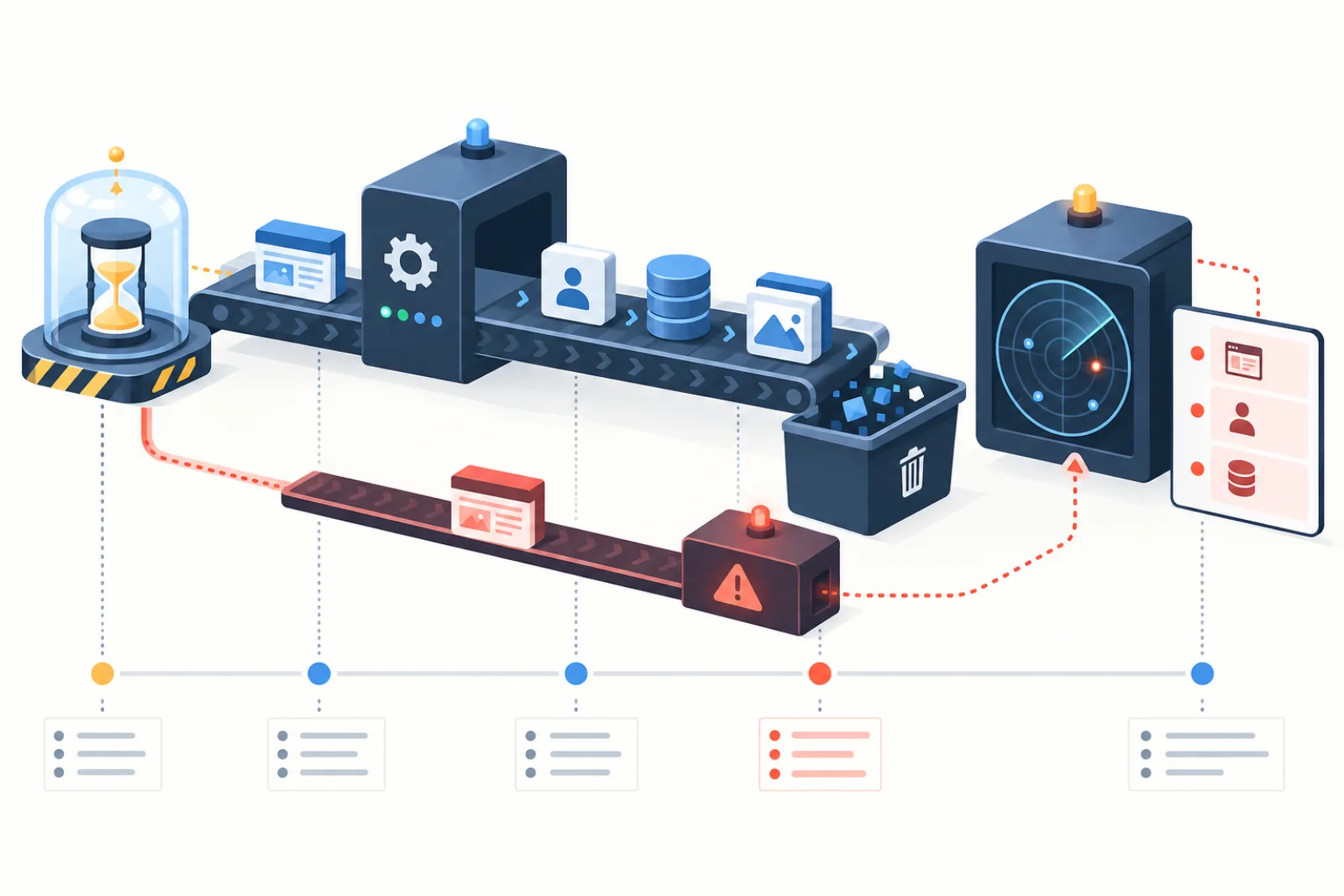
A WordPress demo sandbox is not cleaned up merely because its countdown reached zero. Expiry, deletion and verification are separate states. If the scheduler stops, a deletion hook fails, or a user is shared across sites, temporary subsites and accounts can remain long after visitors leave. The reliable fix is an idempotent cleanup pipeline backed by a reconciliation job—not a larger “delete” button.
Recognize the residue before deleting anything
Start with an inventory from Network Admin and the database, then compare it with the sandbox session registry. Classify every record as active, expired, deleting, deleted or orphaned. Do not infer status from a URL returning 404: routing can fail while tables, uploads and users still exist.
| Residue | Likely cause | Evidence to collect |
|---|---|---|
| Expired subsite still opens | Cleanup event never ran | Next cron time, last successful run, event log |
| Site row gone, tables remain | Partial deletion or hook failure | Site ID, prefixed tables, PHP error log |
| User remains after site deletion | Network user was not safely removable | Memberships on every site, content ownership |
| Uploads remain | Filesystem/object-storage cleanup failed | Bucket/path listing and deletion response |
| Session says “deleting” indefinitely | Worker crashed without retry | Attempt count, lock owner, last error |
Why WP-Cron commonly creates a cleanup gap
WP-Cron is triggered by page loads, not by a continuously running daemon. A low-traffic demo network can therefore leave due work waiting; a busy network can trigger overlapping workers if locking is weak. Confirm that the cleanup hook exists, has a future schedule and actually completes. Run the specific event manually in staging and capture its exit status and duration.
For time-sensitive cleanup, invoke WordPress cron from a server scheduler and monitor it. A successful HTTP request to wp-cron.php is not sufficient evidence that the target event succeeded. Prefer a command that runs the named hook, records output, alerts on failure and cannot overlap itself.
Model deletion as a state machine
Move an expired session from active to deleting with an atomic claim. Delete child resources in a deliberate order, record each result, then mark the session deleted. If the worker exits midway, the next attempt should resume safely. That requires idempotency: “already absent” must normally count as success, while permission or database errors must remain visible.
- Prevent new logins and revoke outstanding launch tokens.
- End authenticated sessions for the temporary account.
- Capture the site ID, user ID and storage paths in the cleanup record.
- Delete the temporary site through supported Multisite APIs.
- Delete the temporary user only after proving it has no legitimate membership or owned content elsewhere.
- Remove external storage, cache and auxiliary records owned by the sandbox.
- Verify absence independently, then close the record.
Treat Multisite users with special care
WordPress Multisite stores users at network level. Removing a user from one subsite is different from deleting that person from the network. The core wpmu_delete_user() function removes the user, memberships and authored content across all sites. A cleanup worker must never call it simply because one demo subsite expired. Give every temporary account an unambiguous sandbox marker, prohibit reuse for real work and check all memberships before network deletion.
Reconcile desired state with actual state
A separate reconciliation job should periodically scan in both directions: session records whose resources still exist after expiry, and demo-marked sites/users with no owning session. Use stable IDs rather than parsing subdomain names. Reconciliation should report first, then repair according to a documented policy. This catches failures caused by disabled plugins, restored backups, manual database work and crashed workers.
Safe recovery procedure
Take a database and uploads backup, test restore, and place public launching into maintenance mode. Export the candidate site/user IDs and their ownership evidence. Process a small batch in staging, verify the network’s primary site is excluded, then run production batches with rate limits. After each batch, check site rows, site tables, uploads, user memberships, object cache and sandbox records. Keep an immutable log of what was attempted and why.
Observability that prevents recurrence
- Age of the oldest expired-but-not-deleted session.
- Cleanup attempts, successes, retries and terminal failures.
- Deletion duration by phase.
- Count of orphaned sites, users and storage prefixes.
- Scheduled hook presence and last successful completion.
- Capacity consumed by expired resources.
Alert on backlog age, not just error count. A silent worker that never starts produces no application error but still leaks resources.
Separate retryable failures from quarantine
Retry transient database, lock and storage errors with bounded backoff. Quarantine records that fail repeatedly, preserve their evidence and alert an operator. Never loop forever on one sandbox while newer expirations accumulate behind it. A dead-letter view should show the resource IDs, completed phases, last error and the exact safe action available next.
Define every cleanup layer
List sandbox database rows, posts, users, user meta, uploaded files, generated derivatives, cache keys, object-storage objects, search records, queue jobs, DNS or proxy routes and external service artifacts. Deleting the WordPress user is not proof the environment is gone.
Assign an authoritative identifier that follows the sandbox across every layer.
Use an explicit cleanup state machine
Model active, expiring, cleanup-queued, cleaning, retry-wait, quarantined, deleted and verified. Record timestamps and last error. Only verified means reconciliation found no in-scope residue. A partial failure must remain visible and retryable.
Transitions should be idempotent so the same job can safely resume after a crash.
Acquire cleanup ownership atomically
Use one atomic claim with worker ID and expiry. A read-then-write flag allows two cron requests to delete the same resources concurrently. The lease must renew during legitimate long work and expire after a dead worker.
Provide an administrative release that first checks active execution and logs the decision.
Understand WP-Cron timing limits
WP-Cron runs when requests arrive after events are due and can be delayed on quiet or unhealthy sites. Use a real scheduler for predictable invocation where operations require it, while keeping cleanup idempotent. Prevent request-driven and system-driven invocations from overlapping.
Monitor oldest overdue sandbox, not only whether an event is scheduled.
Delete child resources before identity
Keep the sandbox identity and manifest available while removing posts, files, tokens, routes and external artifacts. If the owner record disappears first, retries may no longer know what belongs to the environment. Mark deletion intent, clean dependencies, then remove identity last.
Retain a minimal tombstone for audit and duplicate-request safety.
Handle Multisite users carefully
Removing a user from one subsite is different from deleting the network user. Check memberships, owned content and business policy across sites. Reassign or remove content deliberately. A demo account that also belongs to a real site must not be deleted network-wide.
Use blog-aware identifiers and test Network Admin behavior.
Reconcile posts and metadata
Inventory posts, revisions, comments, terms, options and custom plugin tables tagged to the sandbox. Use supported deletion APIs so hooks and relationships run, but verify those hooks are idempotent and bounded. A plugin-owned table may not follow ordinary post deletion.
Record removed, skipped and failed counts per resource class.
Reconcile uploads and generated files
Map original uploads, thumbnails, WebP variants, exports, temporary archives and builder CSS. Validate paths to prevent traversal outside the sandbox root. Do not recursively delete a broad shared uploads directory based on an untrusted ID.
Compare the manifest with disk after cleanup and quarantine uncertain files.
Reconcile object storage and CDN
Delete only objects with the sandbox’s validated prefix or tags, using version-aware APIs. Versioning and deletion markers can leave billed storage. Purge CDN paths after origin deletion and monitor requests during the observation window.
Transient remote errors should retry with backoff; permission errors need operator action, not infinite retries.
Reconcile queues and scheduled events
Cancel future jobs owned by the sandbox and make already-running jobs verify active state before writing. Stable job IDs prevent duplicate reset or cleanup. Inspect dead-letter queues and recurring events that may recreate content after deletion.
Do not remove shared scheduled hooks whose arguments distinguish other sandboxes.
Invalidate sessions and launch tokens
Expiry must block new access even before cleanup completes. Revoke login links, sessions and API tokens at the transition to expiring or cleanup-queued. Check authorization against current sandbox state on every sensitive request.
A cached capability decision must not outlive expiry.
Classify retryable and permanent failures
Timeouts, temporary database deadlocks and object-store throttling can retry with capped exponential backoff and jitter. Invalid paths, missing permissions and corrupt manifests need quarantine. Store error class, attempt count and next action.
Stop retries before they create a permanent background storm.
Build a reconciliation job
Periodically compare desired state with database, filesystem, object storage, queues and access tokens. Find overdue active environments, deleted sandboxes with residue and resources without a known owner. Keep unknown separate from clean.
Reconciliation repairs drift that event-driven cleanup missed and provides capacity truth.
Worked case: deletion removes the user too early
A cleanup hook deletes the demo user, then fails while removing uploads. The retry queries resources by user ID but the ownership record is gone, leaving files indefinitely. Operators see no active sandbox and assume success.
The revised workflow keeps a manifest and tombstone, cleans children first and verifies every layer before final identity removal.
Worked case: object versions retain storage
Current objects disappear, but bucket usage continues growing because versioning preserves old media and deletion markers. The dashboard reports freed bytes using only live keys.
The team distinguishes current, retained-version and physically reclaimable bytes, applies the approved lifecycle policy and verifies billing metrics after retention.
Run safe manual recovery
- Freeze new launches for the affected pool if capacity is at risk.
- Capture sandbox manifest, state, attempts and last error.
- Revoke access tokens and sessions.
- Repair the owning dependency or permission.
- Resume one idempotent cleanup.
- Reconcile every storage layer.
- Close or quarantine with explicit evidence.
Monitor cleanup service objectives
Track due-to-start delay, completion duration, retry count, oldest overdue item, quarantine age, residual resources, reclaimed bytes and scheduler health. Alert on sustained backlog or any access after expiry. Segment failure class so operators can act.
Protect logs from tokens, personal data and raw paths that expose server layout.
Definition of done
Access is revoked at expiry, cleanup has one owner and is restartable, all database/file/object/queue layers reconcile to zero in-scope residue, Multisite identity rules are preserved, and a tombstone records outcome. Failure injection, retry, quarantine and manual recovery pass, while capacity dashboards report verified—not assumed—reclamation.
Audit why cleanup was missed
Build a timeline from expiry, scheduler due time, job claim, resource deletion and verification. Determine whether the event never ran, ran late, lost its lock, exhausted time, failed a dependency or reported success prematurely. Fix the first broken transition.
Retain a healthy comparison and align clocks across logs.
Check scheduler registration
Verify the expected event, arguments and next due time, then inspect whether duplicate events exist. Plugin activation, update or deactivation can leave stale schedules. Remove only exact sandbox cleanup events and preserve other jobs sharing a hook with different arguments.
Use an external scheduler where timing matters, with one ownership mechanism.
Bound cleanup batches
Process a limited number of environments or resources, checkpoint and yield. A job that attempts the entire backlog may exceed PHP or proxy limits and restart from the beginning. Stable cursors and idempotent item deletion allow progress.
Prioritize expired access and oldest residue while preserving fair recovery.
Handle deletion hooks
WordPress and plugins may run callbacks during site, post or user deletion. Profile their cost and failure behavior. A remote webhook inside deletion can strand local cleanup. Queue noncritical notifications after state is durable.
Keep required compliance or billing actions reconciled and idempotent.
Protect shared infrastructure
Validate database prefix, blog ID, filesystem root, bucket prefix and cache namespace before destructive work. Reject ambiguous or traversal-prone paths. Never construct a recursive target from untrusted user input.
Use recoverable quarantine for uncertain artifacts and require operator review.
Manage quarantine
Quarantine needs reason, owner, retry eligibility, next action and maximum age. Access remains revoked. Operators should repair permissions or manifests, retry one environment and reconcile before releasing a batch.
Alert when quarantine exceeds capacity or service objective.
Test restoration and mistaken deletion
Before broad cleanup, restore one backed-up synthetic environment, including database, files and identity relationships. Measure recovery time. A cleanup backup that cannot reconstruct the sandbox is not an adequate safety control.
Protect backups from public access and separate their failure domain.
Reclaim capacity honestly
Report database rows/tables, current file bytes, inodes, object versions, cache keys and queue jobs separately. Physical database files and versioned buckets may shrink later according to maintenance and retention. Do not count candidate or logically deleted bytes as immediately available.
Admission control should use verified usable headroom.
Prevent resurrection
Scheduled imports, delayed webhooks or stale queue jobs can recreate data after deletion. Every writer must check current sandbox generation and active state before commit. Cancel known jobs and reject old-generation work.
Monitor writes to tombstoned identifiers as security and lifecycle incidents.
Close the incident
Document root cause, affected sandboxes, exposure window, residual checks, corrective code/configuration, rollback, scheduler ownership and regression tests. Confirm no user retained access after expiry. Remove temporary manual scripts and elevated credentials.
Reopen launch capacity only when backlog and verified storage return inside the operating envelope.
Audit cleanup permissions
The worker needs authority to remove sandbox resources but should not hold broad unmanaged credentials. Scope database, filesystem, object and network access to validated namespaces. Rotate credentials exposed during manual recovery and keep them out of logs.
Test a denied permission intentionally so the job quarantines rather than claiming deletion.
Check timeout boundaries
PHP, proxy, CLI and remote APIs can impose different time limits. Record where a killed cleanup stops and whether the checkpoint persists. Break long work into bounded units that finish within the shortest reliable boundary.
A longer global execution limit can worsen worker saturation and is not a substitute for resumable design.
Manage database transactions carefully
Do not wrap remote object deletion and thousands of rows in one long transaction. Keep state transitions atomic while resource operations remain idempotent and reconciled. Long locks can block active demos and administration.
Record committed progress so a retry neither repeats harmful side effects nor skips residue.
Test concurrent manual and automatic cleanup
An operator may click delete while the scheduler starts. Both paths must acquire the same ownership lease and use the same lifecycle logic. The loser should report the active owner rather than launching a second deletion.
Test duplicate clicks, delayed responses and worker restart with synthetic environments.
Preserve evidence without retaining user data
A tombstone needs sandbox ID, generation, timestamps, counts, outcome and safe error classes—not visitor content or raw tokens. Apply retention and access policy. Keep backups only as long as recovery and compliance require.
When personal data cleanup is legally time-sensitive, alert and escalate quarantine accordingly.
Prevent repeat incidents
Add the failing dependency and transition to the release test matrix. Monitor recurrence by cause and confirm the next plugin or infrastructure update retains the fix. Review cleanup throughput whenever demo lifetime or launch rate changes.
A closed ticket without a reconciliation check leaves the same hidden capacity risk in place.
Test cleanup during deployment
Deployments can restart workers, change schemas or replace code while old cleanup jobs still run. Test an active, expiring and quarantined sandbox across a staged upgrade. Jobs must recognize compatible state or stop safely for the new worker to resume.
Do not deploy destructive schema removal before every existing manifest can be interpreted or migrated.
Verify scheduler ownership after recovery
Confirm exactly one system invokes cleanup, that WP-Cron and external cron do not duplicate work, and that the lock functions across application nodes. Record command, cadence, timezone, alert and owner. Run a synthetic expired sandbox through the actual scheduler.
Keep the canary quiet on success and alert when access, start delay or reconciliation exceeds the objective.
Publish an operational recovery report
Show affected count, oldest overdue age, failure classes, verified resources reclaimed, quarantine, security exposure and corrective controls. Separate logical deletion from physical storage recovery. Include known blind spots and next review.
Protect raw manifests and visitor data while giving operators enough evidence to prevent recurrence.
After the observation window, run reconciliation again and compare launch capacity with the pre-incident baseline. Close the incident only when no expired sandbox accepts access, retry queues are bounded, quarantine has owners and verified usable headroom supports the configured admission limit.
Run one additional synthetic lifecycle through the corrected production scheduler: provision, modify, expire, revoke, clean and reconcile. This proves the fix works through routing, database, storage and job infrastructure rather than only through a manual recovery command. Keep canary identifiers separate from visitors, prevent external side effects and alert only if a transition or cleanup objective fails.
Inspect the canary tombstone after the observation window and compare it with actual database, filesystem, object-store, cache and queue inventories. A clean administrative list is not authoritative if shared infrastructure retains objects. Record which stores were queried and which could not be verified.
If any layer remains unknown, keep the cleanup state quarantined and reserve its estimated capacity. Assign the system owner, required credential or repair action; do not convert uncertainty into a successful deletion merely to clear an operations dashboard.
How WPStack Sandbox Manager fits
WPStack Sandbox Manager 0.3.2 is described as creating isolated Multisite demo subsites with timed expiry and deletion of temporary sites and users. It supports WP-Cron cleanup and documents a server-cron command for the wpstack_demo_cleanup event. It also exposes recent sessions in Network Admin.
Limits still matter: it is self-hosted, requires WordPress Multisite, and your hosting, DNS, SSL, scheduler and capacity remain your responsibility. Verify cleanup end to end on the installed version; do not assume that an expired countdown proves resources are gone.
Related WPStack guides
Frequently asked questions
Why are expired sandbox sites still present?
The cleanup hook may be late, missing, locked or failing. Check the named event and its last successful completion rather than the countdown alone.
Can I delete leftover Multisite tables manually?
Only as a researched recovery step after backup. Supported site-deletion APIs run lifecycle hooks and reduce the risk of leaving related state behind.
Should every expired sandbox user be deleted?
No. First prove it is a dedicated temporary account with no membership or content elsewhere on the network.
How often should reconciliation run?
More frequently than the maximum acceptable residue window. Base the interval on session volume, cleanup duration and storage risk.
What is the most useful cleanup alert?
The age and count of expired sessions whose resources still exist, paired with the last successful worker run.
References
- WordPress Plugin Handbook: WP-Cron
- WP-CLI cron event commands
- WordPress wp_delete_site()
- WordPress wpmu_delete_user()
- WP-CLI site list

Aditya Bhimrajka is a technology entrepreneur, product strategist, and software solutions expert with over a decade of experience building scalable web and mobile applications. His expertise spans SaaS, AI, cloud technologies, custom software development, and digital transformation. Passionate about solving real-world business challenges through technology, Aditya shares practical insights on WordPress, plugins, software development, startup growth, product strategy, and emerging technologies. At WPStack, he writes actionable, experience-driven content that helps developers, businesses, and website owners build secure, high-performing, and future-ready WordPress solutions.