
WooCommerce Extension Development: A Founder’s Checklist Before You Hire a Developer

A custom WooCommerce extension is one of the fastest ways to lose $50k and six months if you skip discovery. Most failed Woo projects do not blow up because the developer was bad. They blow up because the founder hired before knowing what they were buying. This checklist covers ten questions, realistic 2026 budgets, and engagement models.
Why most Woo extension projects blow up
- Scope was a wishlist, not a spec. The brief said “build a subscription engine like XYZ” instead of “dunning emails on day 3, 7, 14 with a Stripe handoff.” Ambiguity becomes change orders.
- The developer picked Woo when Woo was the wrong tool. A simple configurator does not need a custom plugin. A B2B pricing matrix with custom tax rules probably does. Most projects sit in between, and that middle is where damage happens.
- Nobody owned post-launch. The extension shipped and sat untouched while WordPress, PHP, and WooCommerce versions moved on. Six months later checkout broke and nobody knew why. The silent killer of in-house Woo work.
The 10-point pre-hire checklist
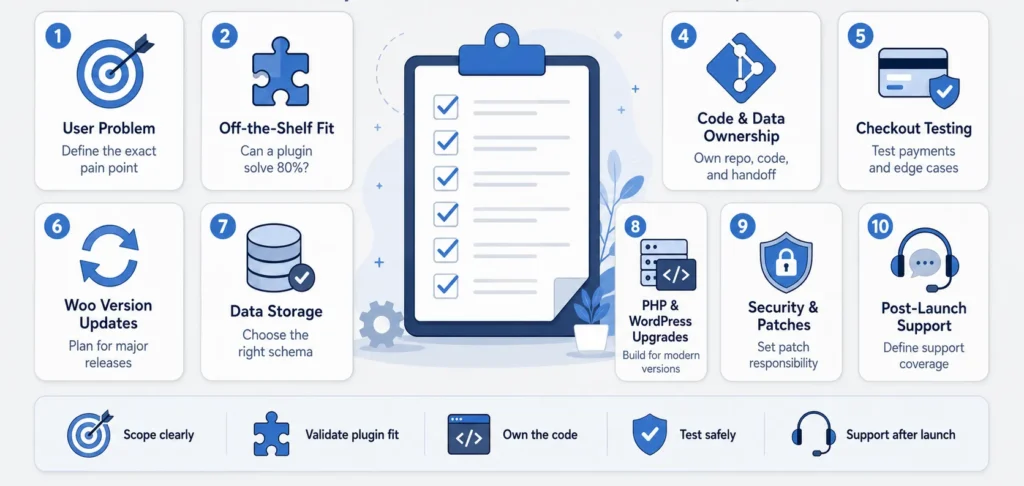
Run every item below before talking to a developer. If you cannot answer it in one paragraph, you are not ready. Almost every failed Woo project skipped a few of these questions.
1. What exact user problem does this extension solve?
Why it matters: this is the question that separates a custom build from a Squarespace template. “We want it to look cool” means stop.
What most founders say: “We need a custom checkout because customers are confused.”
The right answer: “12 percent of B2B customers abandon at shipping because we cannot show tiered freight quotes tied to their account group. GA4 data.”
2. Can a paid plugin off the shelf do 80 percent of this?
Why it matters: custom WordPress plugins start around $5k. A $99 plugin often gets you most of the way.
What most founders say: “We looked, nothing fits.”
The right answer: “We trialed YITH, WooSubscriptions, and a custom fork. Neither handles usage-based metering or role gating. The last 20 percent needs custom work.”
3. What does success look like in 90 days?
Why it matters: a 90-day target forces a Minimum Viable Extension. Without one you ship a six-month build missing the feature.
What most founders say: “Live on the site.”
The right answer: “In 90 days, logged-in customers configure a bundle, see a tiered price, and check out with stored payment. Configure-step abandonment drops below 20 percent.”
4. Who owns the data and the code at the end?
Why it matters: the most common source of hostage code. If the developer owns the repo, you do not own the extension.
What most founders say: “We never asked.”
The right answer: “We own the GitHub repo from day one. Tagged release, admin access, and a written architecture doc at handoff.”
5. How will you test checkout and payments?
Why it matters: a broken checkout loses money by the minute. Edge cases like 3DS, partial refunds, and failed recurring charges are where extensions fail silently.
What most founders say: “We’ll test before launch.”
The right answer: “Stripe sandbox, Woo staging, and a test plan covering 3DS, partial refunds, declined cards, and pause and resume. Run before every release.”
6. What happens when WooCommerce releases a major version?
Why it matters: Woo ships a major every 12 to 18 months. Deprecated API hooks mean a broken cart overnight.
What most founders say: “We’ll deal with it then.”
The right answer: “Developer tests against Woo beta within 30 days of any major. We budget 15 percent per year for compatibility.”
7. Where does the extension store custom data?
Why it matters: custom Woo tables versus post meta is a performance and migration choice, not stylistic. Get it wrong and the database slowly dies.
What most founders say: “In the database, I guess.”
The right answer: “Custom Woo tables for order line items, given 200k+ order volume. Cart metadata in session. Benchmark with 50k synthetic orders first.”
8. What is the upgrade story for PHP and WordPress?
Why it matters: WooCommerce 9.x and WordPress 6.x require PHP 8.1+. An extension on 7.4 will block your site from upgrading, the most common reason Woo sites get stuck.
What most founders say: “We are on PHP 7.4 but we’ll upgrade later.”
The right answer: “PHP 8.2 and WordPress 6.5 from day one. Typed properties, named args, nothing pre-8.0 deprecated, phpstan level 6 in CI.”
9. Who handles security and vulnerability patches?
Why it matters: extensions are a frequent attack surface because they touch payment flows. A silent SQL injection is a PCI incident waiting to happen.
What most founders say: “We will if something comes up.”
The right answer: “14-day SLA on critical patches. Prepared statements, nonces, capability checks, quarterly security review.”
10. What does the support tier look like after launch?
Why it matters: shipping is the start of the relationship. Without a paid support tier, the extension becomes abandonware when the developer takes a new client.
What most founders say: “Email us when something breaks.”
The right answer: “Monthly retainer for 4 hours of bug fixes and Woo patches. Bigger work scoped separately. 30-day cancel clause.”
Realistic 2026 budget ranges
These ranges come from 2025 and 2026 engagements. Treat them as ballpark, not quotes.
| Project type | USD range | Timeline | Who can do it |
|---|---|---|---|
| Tiny extension (single field, admin UI, basic logic) | $3,000 – $8,000 | 2 – 4 weeks | Solid freelance Woo developer |
| Checkout tweak (custom field, conditional logic, gateway hooks) | $6,000 – $18,000 | 4 – 8 weeks | Mid-level Woo freelancer or small studio |
| Subscription add-on (custom billing cycles, dunning, customer portal) | $15,000 – $45,000 | 8 – 14 weeks | Specialized Woo agency or senior freelancer |
| Headless integration (Next.js or Astro frontend, WooCommerce REST + custom auth) | $40,000 – $120,000+ | 12 – 24 weeks | Full Woo agency with headless experience |
A rule of thumb: under $10k means a freelancer. Above $50k means an agency with a PM, QA layer, and code review. The middle is where founders get into trouble by hiring a freelancer for an agency-sized problem.
Engagement models for Woo work
Productized shop. Fixed-scope package, fixed fee, fixed window. Works for tiny extensions and small checkout tweaks. Fails on custom data models and integrations because the model assumes the problem is generic.
Freelance developer. Hire a Woo specialist directly, hourly or fixed-price milestone. The most common path for small-to-mid projects with the best price-per-hour ratio. Risk is single-point-of-failure: if the developer gets sick, takes a job, or ghosts, the extension sits half-built. Mitigate by owning the repo from day one.
Agency with PM and QA. Sign an SOW with a studio assigning a PM, lead dev, and QA. Costs more per hour but de-risks anything above $50k or touching payments. Absorbs bus factor and brings process.
What to put in your brief
A good brief is a structured document that lets a developer quote accurately and skip ten discovery calls.
- The single user problem this extension solves.
- Who uses it (admin, customer, both) and rough traffic or order volume.
- Three to five reference sites or plugins to imitate.
- Explicit in-scope and out-of-scope list.
- Current stack: WooCommerce version, WordPress version, PHP version, hosting.
- Payment gateway, shipping providers, and external APIs the extension must talk to.
- Data model notes if you know what custom fields or tables you need.
- Success metrics: what number moves after launch.
- Budget range and target launch date, treated as a target.
- Who owns the repo, the data, and the documentation at handoff.
Red flags when talking to agencies
- They quote on the first call. A fixed number before reading a brief is guessing. They will pad the quote or underbid and burn hours mid-project.
- No discovery phase in the proposal. Serious Woo work starts with a paid or free scoping sprint that produces a written spec. Jumping straight to build means building the wrong thing.
- They cannot name a recent WooCommerce project. Woo is a deep ecosystem. A portfolio of only landing pages means your extension is their learning curve.
- One person does everything. Sales, PM, dev, and QA in one freelancer is fine for a $5k job. For a $40k extension it is a bus-factor problem.
- No repo or staging environment mentioned. If they plan to develop on your live server via FTP, run. A Git repo and staging URL should appear on day two.
- “We will figure out the data model later.” The data model drives 60 percent of build cost. Vague answers on tables and indexing mean a month-four rewrite.
Green flags when talking to agencies
- They push back on scope. A good Woo studio tells you which features to drop and which will double the cost. Every yes is selling, not engineering.
- They demo a real WooCommerce extension they built. Not a screenshot. A live URL where you poke at admin, add to cart, and inspect the code.
- They write the spec with you, not for you. The studio drafts the spec, you fill in product context, and both sides sign off.
- They quote in ranges with assumptions listed. “USD 18k to 24k, Stripe and Woo Subscriptions as the base, custom dunning out of scope” is professional. A single number is not.
- They have a named PM and a code review process. Two developers, peer review, and a PM who owns the timeline. The minimum bar above $25k.
- They offer a post-launch retainer in writing. A studio that only wants the build does not want to live with the code. The retainer is the safety net.
Post-launch you cannot skip
Most founders treat launch as the finish line. It is not. A Woo extension without maintenance is a liability.
Support tier. Bug fixes need a clear channel and guaranteed response time. Without one, small issues pile up. Budget 10 to 20 percent of original build cost per year.
Security updates. WordPress, WooCommerce, and your gateway ship security patches regularly. Your extension must absorb them. Subscribe to the WP security list.
WP and Woo compatibility. WordPress ships a major every 4 months, WooCommerce every 12. Each can deprecate an API your extension uses. Test against the beta within 30 days.
PHP upgrade cadence. PHP 8.1 is security-only, 8.2 the minimum, 8.3 your target. Every version brings deprecations; keep up or your host will force the upgrade and break you.
When NOT to build a custom extension
Scenario 1: A $99 plugin covers 95 percent. If only a label or CSS tweak is missing, you need a child theme or a few filters. Custom build is the wrong tool. See our custom plugin vs SaaS breakdown.
Scenario 2: The real problem is your checkout flow, not your stack. If 70 percent of carts abandon at checkout, the fix is payment options, shipping clarity, and trust signals, not a custom extension.
Scenario 3: You need a SaaS, not a plugin. If the feature lives across multiple sites, runs as a hosted service, or exposes its own API, you are building a SaaS. See our custom WordPress plugins cost model.
FAQ
Tiny 2 to 4 weeks. Checkout 4 to 8. Subscription 8 to 14. Headless 12 to 24. Add 25 percent buffer.
Yes. Most integrate via its action and filter hooks. Expect a small bridge layer for billing events.
Only if the contract says so. Standard practice: you own the repo, schema, and docs at handoff.
10 to 20 percent of original build cost per year, covering security patches and compatibility.
Self-hosted. WordPress.com restricts plugin installation on most plans. You need full control over wp-content and PHP.
Official guidance and next steps
Validate your brief against the official WooCommerce extension development practices and compatibility guidance. Then review the custom plugin cost guide or request a WooCommerce extension scope.
Related reading
Before commissioning an extension, review the custom plugin cost model, the production-readiness gate, and the post-launch maintenance checklist.

Aditya Bhimrajka is a technology entrepreneur, product strategist, and software solutions expert with over a decade of experience building scalable web and mobile applications. His expertise spans SaaS, AI, cloud technologies, custom software development, and digital transformation. Passionate about solving real-world business challenges through technology, Aditya shares practical insights on WordPress, plugins, software development, startup growth, product strategy, and emerging technologies. At WPStack, he writes actionable, experience-driven content that helps developers, businesses, and website owners build secure, high-performing, and future-ready WordPress solutions.
Build or Buy a WooCommerce Extension? | WPStack
August 6, 2026 at 9:25 am
“ […] workarounds, training, support, updates, testing, migration, and the cost of failure. Our WooCommerce extension checklist helps prepare the technical […] “