
Free WordPress Plugin or Custom Build? A Practical Decision Guide
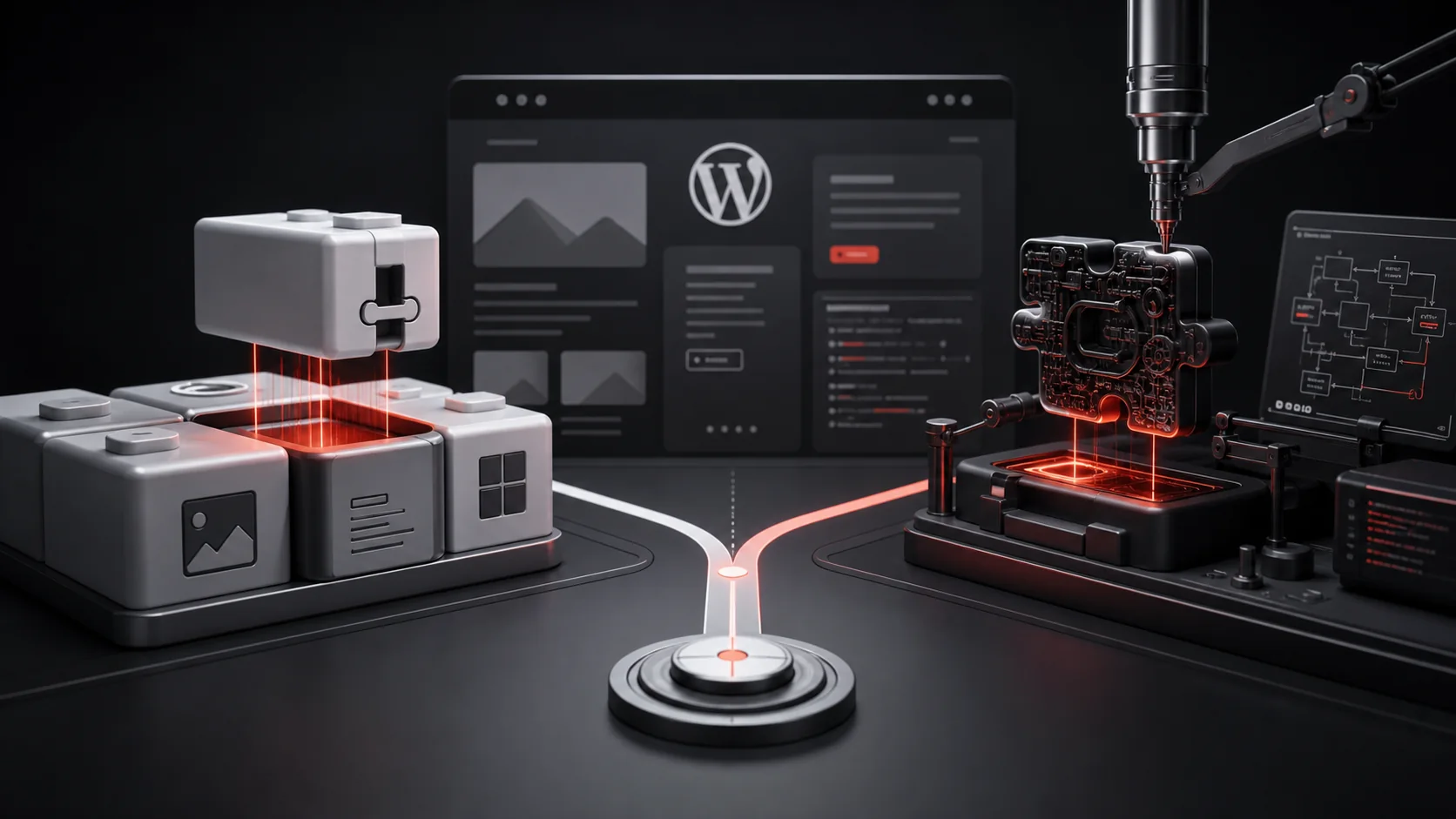
A free plugin is often the right first move. It is installable in minutes, inexpensive to test, and usually backed by users who have already exposed its obvious edge cases. The mistake is assuming that “free” and “custom” describe quality. They describe how closely the software can fit your workflow.
The practical decision is not whether custom code sounds more professional. It is whether an existing plugin can solve the problem without creating unacceptable operational cost, security exposure, data constraints, or workarounds. This guide gives you a repeatable way to make that call.
Start with the business workflow, not the feature list
Write down the outcome in plain language before comparing plugins. “We need a CRM integration” is too broad. “When a paid WooCommerce order reaches processing, create or update the customer in our CRM, attach the correct product interest, and retry safely when the API is unavailable” is testable.
That sentence reveals the real work: event timing, field mapping, deduplication, error handling, authentication, logging, and recovery. A directory search may find a plugin with the right headline but not the operational behavior your team needs.
When a free plugin is the sensible choice
- A maintained plugin already covers the complete workflow, not merely the first screen of it.
- The plugin uses standard WordPress data structures and can be removed without trapping important business data.
- Its permissions, update history, support record, and compatibility range are acceptable for the site.
- The cost of adapting your process is lower than the cost of owning custom software.
- The feature is useful but not strategically distinctive to your product or customer experience.
Free tools are especially effective for focused maintenance jobs. WPStack’s free plugin directory includes tools for diagnosing slow requests, reducing autoloaded-option bloat, auditing unused media, improving alt-text workflows, cleaning promotional admin clutter, and keeping complex Elementor editing sessions responsive.
These are bounded problems with clear interfaces. You can test the tool on staging, confirm the result, and keep your core business model outside the plugin.
Warning signs that configuration is turning into custom development
Teams often avoid commissioning a plugin by adding snippets, automation services, manual exports, and overlapping add-ons. Each piece appears inexpensive. Together they create an undocumented application that nobody clearly owns.
- Staff copy data between systems because the plugin cannot represent one important state.
- Three or more plugins touch the same order, user, membership, or booking workflow.
- A vendor update regularly breaks CSS selectors, webhooks, or undocumented hooks.
- Failure is silent, so the team discovers missed records through a customer complaint.
- Sensitive data passes through extra services solely to connect two systems you already control.
- Renewal costs keep rising while the workflow remains constrained.
At that point, the comparison is no longer free plugin versus custom plugin. It is fragmented custom behavior versus deliberate custom behavior.
When a custom plugin earns its cost
Custom development is justified when the workflow is part of your competitive advantage, when it handles sensitive or high-value transactions, or when failure has a measurable business cost. It also makes sense when you need ownership over the data model, release timing, integrations, and support path.
A good custom plugin should reduce dependencies rather than merely reproduce a page-builder workaround in PHP. It should define capabilities, validation rules, background jobs, logs, upgrade routines, and boundaries with other systems. The result is a product your team can explain and maintain.
Use a weighted decision score
Score each option from one to five across workflow fit, security, data ownership, extensibility, maintenance effort, support quality, performance, and exit cost. Weight workflow fit and failure impact more heavily than setup price. A free plugin that needs daily reconciliation can be more expensive than a focused custom build.
Also price the middle option: configure and extend an existing plugin through documented hooks. A small integration layer can be the best answer when the base product is healthy and the missing behavior is narrow.
A safe evaluation process
- Define the workflow and failure cases before installing candidates.
- Shortlist plugins with active maintenance, clear documentation, and compatible requirements.
- Test on staging with realistic data and the rest of your plugin stack enabled.
- Inspect what happens during failure, retries, deactivation, and uninstall.
- Measure admin and frontend performance before and after activation.
- Document the decision, owner, renewal dates, and replacement plan.
For a new requirement, start in the free plugin directory. If a focused tool solves the problem cleanly, use it. If the workflow is unique or the compromises begin to affect revenue, security, or daily operations, talk to WPStack about a custom plugin with a defined scope and ownership model.
The decision in one sentence
Choose a free plugin when your process can safely fit the product. Choose a custom plugin when the software must faithfully fit the process.
Choose the Right WordPress Plugin Strategy for Your Business
Choosing between a free WordPress plugin and a custom-built solution should not come down to price alone. The right decision depends on how well the plugin supports your workflow, how safely it handles business data, how reliably it performs during failures, and how easy it will be to maintain as your website grows.
A free plugin may be the most practical option when it solves a clearly defined problem without adding unnecessary complexity. However, when your team depends on manual workarounds, multiple overlapping plugins, fragile integrations, or custom snippets that frequently break, the real cost can quickly exceed the initial savings.
WPStack can help you evaluate your current setup, identify operational and technical risks, and determine whether your requirement can be solved through an existing plugin, a focused extension, or a purpose-built custom solution. The goal is not to recommend custom development unnecessarily. It is to help you choose an approach that is secure, maintainable, scalable, and aligned with your actual business process.
Whether you are planning a new workflow, replacing an unreliable plugin stack, or improving an existing WordPress system, WPStack can help you define the scope, ownership model, integration requirements, and long-term maintenance plan before development begins.
Request a Custom Plugin Consultation with WPStack and build a WordPress solution that fits your workflow without unnecessary complexity.
Frequently asked questions
No. A maintained free plugin is usually the better choice when it covers the complete workflow, stores data predictably, and does not create risky workarounds. Custom development becomes valuable when the workflow is distinctive, failure is expensive, or ownership of the data and release path matters.
Often, yes. A focused extension built through documented hooks can preserve a stable base product while adding narrow business behavior. The key is to avoid brittle overrides or a chain of snippets that nobody owns.
Test the real workflow on staging, including permissions, failure handling, performance, updates, deactivation, and uninstall behavior. The production-ready plugin checklist provides a useful evaluation standard.
Request an assessment when multiple plugins touch the same critical workflow, staff must reconcile failures manually, or the process affects revenue, security, or customer experience. A scoped assessment should clarify whether configuration, an extension, or a dedicated build is appropriate.

Aditya Bhimrajka is a technology entrepreneur, product strategist, and software solutions expert with over a decade of experience building scalable web and mobile applications. His expertise spans SaaS, AI, cloud technologies, custom software development, and digital transformation. Passionate about solving real-world business challenges through technology, Aditya shares practical insights on WordPress, plugins, software development, startup growth, product strategy, and emerging technologies. At WPStack, he writes actionable, experience-driven content that helps developers, businesses, and website owners build secure, high-performing, and future-ready WordPress solutions.
WordPress Plugin Security Review Checklist | WPStack
July 26, 2026 at 9:01 am
“ […] Record why the plugin is installed, the data it touches, the person responsible for updates, and the condition that would trigger removal. If the available plugin solves only part of the problem, compare it with our free plugin versus custom development guide. […] “
WordPress Plugin Development Cost: 2026 Pricing Guide
July 29, 2026 at 10:23 am
“ […] the free plugin versus custom build framework before budgeting. Then review production-readiness requirements and request a scoped […] “
Custom WordPress Plugin vs SaaS: 2026 Guide | WPStack
July 29, 2026 at 10:46 am
“ […] this product decision with the custom plugin cost breakdown, the free versus custom decision guide, and the production-readiness […] “
How Autoloaded Options Affect WordPress TTFB | WPStack
July 29, 2026 at 10:57 am
“ […] WPStack’s comparison of a free WordPress plugin versus custom development when evaluating that […] “
Why Unused WordPress Media Is Hard to Detect | WPStack
July 29, 2026 at 11:00 am
“ […] Before selecting a cleanup solution, compare the limitations of a free WordPress plugin versus custom development. […] “